
Definition of limit test:
Limit test is defined as a quantitative or semi-quantitative test designed to identify and control small quantities of impurities which are likely to be present in the substance.
Principle
The principle is based on Gutzeit Test wherein, all arsenic present is duly converted into arsine gas (AsH3) by subjecting it to reduction with zinc and hydrochloric acid. Further, it depends upon the fact that when arsine in the presence of a reducing agent like KI, comes into contact with dry paper permeated with mercuric (Hg2+) chloride it produces a yellow stain, the intensity of which is directly proportional to the quantity of arsenic present. It requires a special apparatus.
Procedure
Take two 5O ml of Arsenic LT apparatus bottles. Label one as “Test” and the other as “Standard”.
| Standard | Test |
| 1. A known amount of dilute arsenic solution is kept in the wide mouthed bottle of the apparatus. | 1. Test solution: Dissolving specific amount of sample in water and stannate HCI (as free) and kept in the wide mouthed bottle of the apparatus. |
| 2. To this solution, 1 gm of KI, 5 ml of stannous chloride and 10 gm of zinc is added (all these reagents should be arsenic free). | 2. To this solution, 1 gm of KI, 5 ml of stannous chloride and 10 gm of zinc is added (all these reagents should be arsenic free). |
| 3. Keep the solution aside for 40 minutes. | 3. Keep the solution aside for 40 minutes. |
| 4. Compare the stain obtained on the mercuric chloride paper with that in the apparatus containing test solution. | 4. Compare the stain obtained on the mercuric chloride paper with that in the apparatus containing standard solution. |
Notes
Arsenic Limit Test Apparatus
A 120 ml capacity, wide-mouthed bottle fitted with a rubber bung through which passes a glass tube of approx. 20 cm and 6-8 mm diameter is used. One end of this tube is constricted like that of a pipette with 1 mm diameter having a hole of 2 mm diameter.
When the bung is inserted in the bottle containing 70 ml of liquid, the constricted end of the tube should be above the surface of the liquid, and the hole in the side is below the bottom of the bung.
The upper end of the tube is cut off square, and is either slightly rounded or ground smooth.
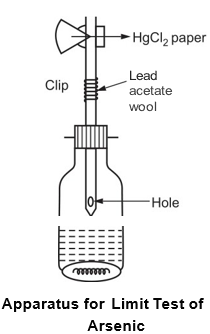
The rubber bungs (about 25 mm x 25 mm), each with a hole bored centrally and through, exactly 6.5 mm in diameter, are fitted with a rubber band or spring clip for holding them tightly in place.
The glass tube is lightly packed with cotton wool, previously moistened with lead acetate solution and dried, so that the upper surface of the cotton wool is not less than 25 mm below the top of the tube.
The upper end of the tube is then inserted into the narrow end of one of the pair of rubber bungs, to a depth of 10 mm (the tube must have a rounded-off end).
A piece of mercuric chloride paper is placed flat on the top of the bung and the other bung placed over it and secured by means of the spring clip in such a manner that the holes of the two bungs meet to form a true tube 6.5 mm diameter interrupted by a diaphragm of mercuric chloride paper.